Consolidated Ink takes order-to-PO from decision to done.
A customer order arrives by email. Purchase orders are drafted for each supplier and wait in your review queue for approval. Only the odd one is flagged, with the reason.
-
990
hours of manual work removed each year
Specific to this bounded Consolidated Ink decision flow; annualized against its observed measurement period.
-
30%
lower process cost
Across the governed decision flow, against the defined manual-task process cost baseline.
- 01 Order arrives by email · ingest
- 02 Vendors and line items checked · transform
- 03 PO decision · decidegoverned Approved-vendor list · spend authority
- An expert decides Approve-first is on. Every PO waits; the odd one is flagged with the reason.they see The order and its line itemsA drafted PO for each vendorWhy one was flaggedthey decide Approve, correct, or hold
- 04 Purchase orders drafted for each vendor · emitheld → approved → released
Your tools handle the tasks. The decisions still wait for you.
Every business has a Friday pile: the calls that sit all week until the busiest expert gets to them. At Consolidated Ink it was customer orders turned into supplier purchase orders, one at a time, on a Friday night. Now those calls run as a decision flow, and the owner still makes the final one.
The owner decides. The rest moves on its own.
This is one order, in the owner’s own tools. Its eleven lines split across three suppliers, and for each one the flow does the work the owner used to do by hand: stock and price from the suppliers’ PromoStandards APIs, where it ships from, when it lands against the print date, and what it does to the margin. The owner approves or corrects each purchase order in Slack. The POs go out, the bills are drafted in Xero and the Trello card moves on, minutes after the order came in. Nothing to migrate, and every decision has a page.
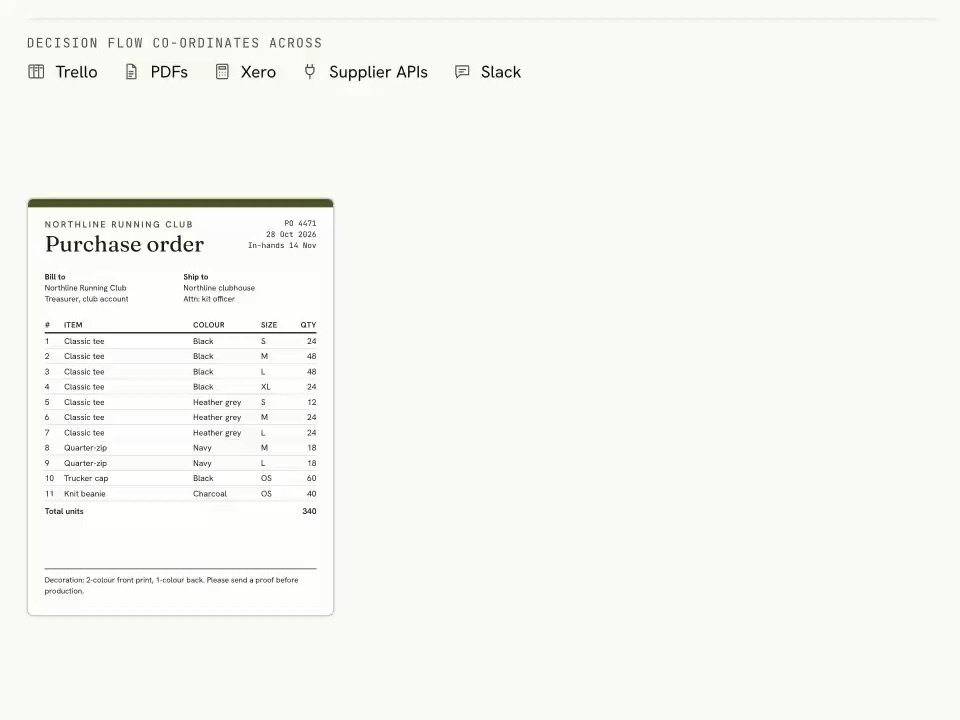
- The customer’s order arrives as a PDF, and a Trello card opens for it.
- Its eleven lines split across three suppliers. Stock and price come back from PromoStandards Inventory and Product Pricing and Configuration.
- Each purchase order gets where it ships from, when it arrives against the print date, and what it does to the order margin.
- Asked in Slack, the owner approves two purchase orders and corrects the one that took the margin under the floor.
- The purchase orders go out over PromoStandards Purchase Order, and the bills are drafted in Xero.
Before and after
Before
Customer orders turned into purchase orders, one supplier at a time, on a Friday night.
After
Purchase orders drafted for each supplier. You approve in the review queue. Only the odd one is flagged.
One decision, walked through
- 01 · Inputs
- A customer order with lines from three suppliers, one at a price that does not match the supplier’s current list.
- 02 · Rule
- The approved-vendor list, current vendor pricing and the owner’s approve-first setting.
- 03 · Permitted action
- Three purchase orders are drafted, one per supplier. The mismatched line is flagged with the reason.
- 04 · Outcome
- All three wait in the review queue. The owner approves two and corrects the third.
“How do I know it’s right, and is my data safe?”
- You approve first
- Approve-first is on. Every PO waits in your review queue, and nothing goes to a supplier until you let it through.
- Every decision has a page
- The order, the supplier, the price and the call, written down. The flagged one shows why.
- Your systems stay in charge
- Framework reads the order from your inbox and drafts the POs. Sending stays with the ordering tools you already run.
Hand off this decision. Done by Friday.
Have customer orders that still become POs by hand? Start there.
A 30-minute session, one decision flow scoped, live by Friday, reviewed after 30 days.